

From the Beer Commercial Archives of Canada
From the non-fiction book: Burly Bush Man
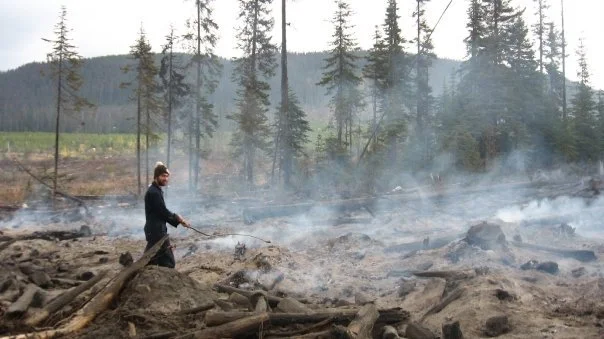
The Burly Men in their pioneering boats, the Molson and the Labatt, first landed on the shores of the northlands when the world was still crisp, smooth, and fresher tasting. Until then, Canada was an untapped wasteland of boring rocks and forests. The trees cast unprosperous shadows over the hills; bears crapped where they were wont; birds were allowed to fill the world with their nonsense songs. Give us a B.T.O. beat, the Burly Men cried to the birds as they stepped from their boats. We must hearken to business. But the birds harked not, and persisted in their blathering.
Before the bringing of hops and barley to the north, water ran frivolously, wasted, over much of the land, making of it a desolate and ungainly place. Yet the Burly Men paid no attention to the pleas of their women or the whines of their teetotallers to leave this new accursed land. They had far vision, and saw the potential for the future. They looked to the great cargoes of kegs and steins they’d brought with them from the ancient shores, then looked back to the wilderness before them, then back to their kegs and steins, and they grinned knowingly, thinking it was good.
Early Canadian man, homo Canuckiensis of the coolest climes, came to live amongst the trees, finally to put those great lumbering sticks of previous no-use to proper purposes. Rivers flowed with wholesome syrups for historic pancake feasts, sweet and sugary after a night’s natural debauchery. The Burly Womenfolk, donning their buckskin bikinis, bared their midriffs joyously in celebration, wrestling in immense sticky vats while the Burly Men belly-bumped broad chests and bro-fisted happily through the prosperous forests of olde.
The Burly Men went on to wrangle the mountains, felling them in best-of-three arm-wrestles, and soon conquered the Spirit of Winter in a totally righteous chugging contest, drawing mustachios and wieners on Winter’s white visage with a black marker when he passed out early on the couch. The marshlands and foolish quagmires of no worth were then drained, strained, and shamed for being too lame.
The great plains were plumped full of grains for fine pale ales, and keg and barrel-makers flourished where the Burly Men ventured. Homo Canuckiensis’ pioneering party was long and spirited, and nobody at all was a buzzkill about it except for a few neighbours who may have been living in the area a while before Homo Canuckiensis showed up to really make the place rock, but then they went away somewhere else where they lived happily ever after or something, and then everything was super cool in the end.
Alas, the time came when the young strayed from their ancestral home in the north. The northlands quieted, the raucous chant of the wild beer-bong was heard no longer. The blathering of birds once again became prominent in the hills, and the bears returned to stalk the undergrowth and litter their heinous berry crap wherever they liked.
But the forest had seeped into the blood of Northern Man. His marrow had become like the surge of sap, the sinews around his bones like limber alder whips. Even in long languorous exile, the descendants of Northern Man remembered the forests in their bellies, and returned often to the ancient lands to make offerings of buns and brews, to swim in the cold veins of the land and honour the spirit of their ancestors with ATV rides over lifeless muskegs, scattering interloper ducks and deer before him. These sons and daughters of the Burly Men returned to praise the wide hemlocks with the guttural cheer of the tractor’s tread, the high-kneed march of caulked boots, the shiny dignity of hard hats. The forests welcomed the burly descendants as old bros and swayed along to the changing song of the chainsaw. Taking care of business. Every day.
——
To work in the woods would be expansive, soul nostalgia. So I felt.
As a boy I remember watching an episode of Dudley Do-Right, that archetype for all men of the north, honest, strong and true. In the episode, Dudley’s arms were declared weak wimpy noodles. Nell, that portrait of Canadian womanhood, could best him in an arm-wrestle, rip him right away from the table. Horror of horrors, Dudley had become puny. As a consequence, evil Snidely Whiplash, with his black villain hat and itch for making a quick buck, quickly made a splattered apple of the emasculated Dudley.
To hide his shame, Dudley slunk off into the refuge of the woods, leaving a slime trail of weakness behind him. There he worked as a lumberjack making V’s in trees, and in just four weeks returned from the woods mighty with flannel to show Nell how non-puny he had become, and made Snidely Whiplash piss pink for a few weeks. That’s partially what I expected from the woods: to become manly, strong, and industrious, the spirit of Dudley Do-Right watching from behind every tree, nodding his anvil chin.
The woods, where every broken bough is a fallen cradle and men are swaddled in red-checkered flannel. Where forests and lakes pile atop one another and pile atop men to make sacred totems to beer drinking and fireside enlightenment. Where men wield chainsaws and mountains wield men. Where books don’t matter because the land reads you and determines if you are worthy. Where men never shave and become prickly with shields of character. Where pipes are smoked fragrantly by winter woodstoves. The musk of sweaters seldom washed. The greasy-leather scent of boots drying by the fire. Dinner caught by hand, snared, shot, felled, skinned, worn. Where men are broad and the women long-haired and sun seasoned. Where Wordsworthian thoughts fall from trees to wrap around necks and sling fangs, to not breathe then of ordered nature, strains of English countryside, but wild nightmare ranges of destroyer clouds, pangs of sunsets over the prostrating treetops. Where your blood turns to sap and your heels press leaf impressions into the loamy soil. Where you add layers to the outside until you become broad, tall, and steady like the trees. Where a man in shiny loafers wakes with a howl, the woods within him stirring. Where manicured hands hold the product at breast level right before somebody cannonballs into a lake with their clothes on. Where faces are superfluous and jeans are worn tight over taut haunches.
——
My grandfather left home when he was fifteen. He left home spectacularly.
The Port au Port Peninsula on the west coast of Newfoundland in the 1930s was a secluded place in the winter months. A tether of boats tentatively hopped harbour to cove to inlet when the pack ice allowed. People huddled in their familial dens waiting for their worlds of ice and snow to bloom once more, reprieve from their long tubercular tilt away from the sun. Back then all sorts of people suffered the same sorts of tortures as Poe. Most dealt with it better than he did.
My great-grandparents died during a tuberculosis outbreak when my grandfather was only seven years old. He and his brother and sister were then led through town, hand in hand, door to door, until they were all taken in. My grandfather ended up being raised by a kindly neighbour, Mr. Harvey. His sister and brother were adopted by other families.
One spring morning, over jam-toast and tea, my grandfather Harry told the man, “I’m going to Corner Brook today with Jim Lundrigan to work for the mill. He’s starting down round twelve.”
They’d had this argument before. Mr. Harvey thought of Harry as his own son, and he looked the boy over. Harry had grown tall and square of shoulders. He was a capable boy, and sensible. But times were tough; there were no guarantees to be had anywhere. Corner Brook was a couple of hundred kilometers away, and he needed the boy, only fifteen years old, for chores, and to help out around the farm.
On the other hand, boys his age had already gone to Labrador with boats that spring.
“I need you here,” he said, as always.
“I’m going.”
“Well, if you gets your chores done by noon, then get on with you, but if you takes off now in the middle of harvesting, you ever comes back here I’m gonna get my gun.” Mr. Harvey knew the boy would be hard pressed to finish his chores by noon. And the threat would make him think twice.
My grandfather rushed through his morning chores, feeding the cows, the chickens, the horses. Noon came quickly, and then slipped past. Nevertheless, knowing Jim Lundrigan wasn’t very prompt, Harry reined one of Mr. Harvey’s horses without permission and spurred it as fast as it would carry him over the hills and around the point. As he galloped into the bowl of the bay, deep in the mouth of the harbour in the distance he saw Jim Lundrigan’s boat still moored, its engines chugging.
He tied the horse to a post on the wharf, yelled to someone he recognized to tell Mr. Harvey where to find it, and gave Jim Lundrigan his promised five-cent fare. Not long after, the boat slipped away out into the choppy waters of the Gulf of St. Lawrence.
In Corner Brook, young Harry landed a job at the Bowater mill driving logs down the Humber river, dancing like water over the dams and the jams with his long pole, and he started a family, apparently pleasing my grandmother—young Mary from Sally’s Cove—completely, fathering twelve children, nine girls and three boys. Every few new additions he tacked another room on to the house and carried on with his dancing.
——
When I was nine years old, my grandparents came to our house for dinner on their fortieth wedding anniversary. My new Transformers board game was needlessly algebraic. You counted Bumblebee and subtracted Optimus Prime and you equaled Megatron.
“Play with me, Pop. Look, it’s easy.”
“No,” he said. “You play. I’ll watch.”
“Please. See. Look.”
Being nine meant I never knew that Pop had never learned how to read the papers he’d made all those years working in the pulp mill. Or do the fairly simple math it took to defeat evil.
I hung around that night while the adults talked. After regaling us with tales of his adventures about his time as a log driver, my grandfather told us about the trip home to Boswarlos to see Mr. Harvey.
“I rapped on his door and didn’t wait for him to answer—wouldn’t want to give the ol’ skipper time to go for his gun. I stuck my head in through the door and I yelled, ‘Any strangers ‘lowed in?’
“He was sittin’ at the table, drinkin’ his tea. He got up and gave me a big ol’ hug. ‘My old gun’s broke anyway,’ he said. Then I brought you eight youngsters in,” he said to my mother. “Every one of ya lined up and shook his hand.”
——
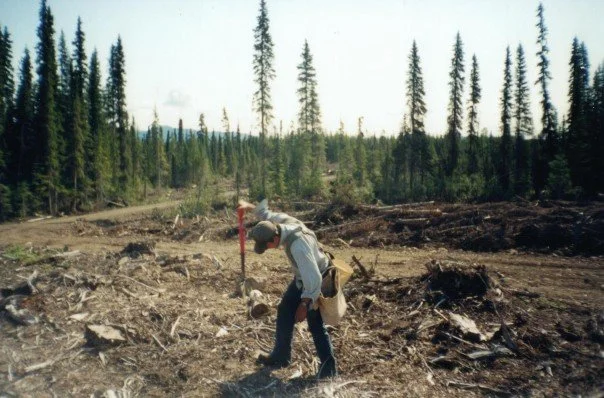
As a kid, I held a grudge for my heritage. My little fists could never be a log hauler’s hams, or hooks for hauling heavy nets into a boat. Even then I knew my little pointers were better for turning pages. One lick of a long finger and the page pries right up. I wanted to be a scientist. I didn’t know what that meant, really, only that I wanted to read until the iridescent glittering goo of knowledge seeped from my ears.
Sixty years ago, in Newfoundland, it was very important to know how to mend a net, ride a horse, pilot a boat, how to read the ocean. For the women: to yarn, darn, sew, how to cook huge meals with little help and few ingredients, how to stave off hunger and keep a family healthy. I knew nothing of any of that and I’d always known it would never be important to me. I was separated from the land in a way my grandparents never could have been, and, as many of us have done, I fostered that separation. The past was a country that I knew no longer existed. Already it was fading and would live on in the future only as a quaint anachronism. I could never go there, and never wished I could.
My grandparents and parents were from that world, I was from another. Watching my grandparents slip away, and my parents turn gray, retire, and dote on my sister’s kids, I could see theirs was a world that wouldn’t be around much longer.
I imagine the whole of the country once underwent the sort of cultural amalgamation and gloss that I saw happening to my home, maybe a little piece at a time, each time a song was forgotten, each time there was no one left to laugh at an old joke. Maybe in twenty years I’ll see the pale reflection of Newfoundland culture being sold back to me in beer commercials and touristy jingles, guys in flannel by cottage lakes replaced by guys and gals in their clean rubbers having good times on fishing boats, hauling in lines with ease, high fives and girls in bare-belly rain slickers.
As the waves grow high, the beer goes down cold.
After I left the island, that separation with my family, and my home, began to rankle, and somewhere in the back of my mind I felt that as I picked up the phone to call Paragon Reforestation and ask them about available spots for their spring contract. Mostly I needed the money, needed someplace to be for two months before field school, and it fit. But I also knew that no matter how hard it was I wouldn’t let that get in my way. I would be a proud continuation of the nimble grace of my grandfather. I would prove that I carried in me the large lined hands of my uncles, their palms scarred maps of long days of black work well done; that in me existed winters in solitude, the happiness of finding the perfect skipping stone, of getting the good hand-me-down pants or a bit of warm molasses on fresh bread; that in me I held crags and spires of mottled rock where sea spray met the sky. If those things could no longer come to me, I would go to them.