

BURLY BUSH MAN
(an excerpt)
The misery and beauty of tree planting in Canada

Logging + a gang of dirty young people + a shovel + a bag of trees = an industry
CHAPTER 10
SHADOWS AND TALL TREES
Rob’s demotion and my transfer to Gerard’s crew came as no surprise. But suddenly all the unwritten rules were different. Hank called Shelly, Josh, and I aside in the morning and told us the news. After Chris the quiet native kid fell and broke his thumb on Friday, and James and Kristy didn’t come back to the bus on Sunday, we were the last surviving members of Rob’s crew.
Rob was a victim of his own work ethic. Regardless of what specs were acceptable, he told us he’d make sure we knew how to do quality work. At the time I couldn’t read between the lines to know that perhaps our perfect darling trees were more Rob’s blueprint than the mill’s. In later years I credited him with my ability to put in a good tree, but in a contract where we were jackhammering trees into the Canadian Shield, and the mill’s checkers obviously had their hands in their pockets and their eyes on their watches, I would have been so much happier if he’d have just let me slam a few trees wherever I was lucky to find three inches of soil.
All contract our crew grumbled that the others had greener pastures. But that’s what rumor is for, inflaming your aches and insecurities and complaints, regardless of company, province, or specs. Problem was, in our case it was true. Different cultures develop among crews, stemming usually from the style of their foremen. The less quality was stressed, the more money people made, and the more likely they were to stay. Our crew consistently had the best quality, the lowest totals, and the most quitters. Kate and Gerard weren’t checking their crews as hard, and to a man they planted more. Every so often they would get sent back to old blocks to do full-crew replants after Hank or Lance or the mill checker lorded through and threw some poor plots. We’d pass word about it at the cache and sneer.The day he was demoted to common drudger like the rest of us, Rob went with Shelly and a couple guys into town after work for a consolation beer or ten. Two hours later, according to Shelly, Rob staggered up from the table, ignored the angry bartender after he drunkenly tossed a chair out of his way and over a table, and lurched outside towards the train tracks just as a train was coming.
They never saw him make it to the other side. Not sure if he’d been hit, Shelly and the guys waited a couple minutes for the long train to pass on into the darkness, and when it was gone and Rob was nowhere in sight, in tears they spent the next while kicking through the tall grass around the tracks, hoping they wouldn’t step in a soup that used to be their friend.
Two cop cars were parked outside the mess trailer when I trudged up for breakfast the next morning. Good news, Rob was alive and had found a bed that night. Bad news, the motel had already rented it out to a gentlemen who hadn’t appreciated rolling over to find—not his beloved wife—but a strange man next to him on his hotel pillow reeking of boozy bedstink.
I didn’t see Rob for two days afterward, when he finally came out of his tent, his cheeks puffy, purple haloes under his eyes the size of plums. It took four days for his rummy racoon eyes to fade. Looking back at it now, I have to wonder if Rob’s surprise bed-buddy gave him those eyes and not the booze at all.
At the time I thought it was brilliant madness.
∞
At the block, Gerard led me to the corner of a piece ribboned in red and said, “Okay, start here. I think there’s a blue line down that way somewhere.” He didn’t look at me when he spoke. He threw his words in the air for me to snare. I had to be ready to catch them.
I looked further down the road, wanting to gauge the distance and the size of the piece. I couldn’t see a blue flag anywhere.
“I like to cut big pieces,” said Gerard. “How long you think this will take you? Two, three days?”
I had no idea. Rob usually cut our pieces into manageable sizes. Done in a day. And yes, the crew bosses cut our pieces for us.
“Well, I like to cut big pieces,” said Gerard. Walking away, he lobbed more words over his shoulder. I was busy surveying the sticks and slash ahead and his instructions fell to secret spots in the dirt. Gerard’s dogs snuffled after them, pushing stones around with their snouts, gobbling them up.
Before me was a dead, drained swamp, a graveyard of bony trees jutting from a sucking floor. In places where the piece lacked mud, it compensated with slash. Across the center wove a bog where the skidders had flattened stunted trees. The slash was thicker down in that depression and the ground wetter, which usually meant squishier places to plant, but also more living trees, if they could be called that, as they were little more than resilient wooden stalagmites.
The sky, as always, resembled a dirty dishrag. Not having showered for a day or two, I felt the humidity like an itchy sweater. The seconds ticked away while I stood there, not wanting to roll into that first step. An hourglass hung over us all. I had come to know and to hate time, always with its whip.
In the back I could see a skid-trail poking down through the woods. Often the choicest trees are surrounded by duds: birches, cottonwoods, aspens, poor garbage trees, cheaper to knock over than to process. The buncher cuts trails through the chaff, clears sections of trees the mill wants, then cuts to the next choice patch. From above, these patches have the profile of an ant farm behind glass. At first glance I thought I had this bomb-crater of a piece along the roadside, but I’d have to enter that labyrinth and follow the trails wherever they led.
Working down the line to the back I was four feet wide with my bags on, and forty pounds heavier, stepping carefully through that quagmire while trying not to poke an eye out. White ghosts of former trees clawed at me with every step; every living tree tried to shove me off my feet. I straddled over logs and bobbed beneath bony naturals, knuckles bumping the bedrock every time I tried to tuck trees in, the cold seep of the black bog lapping over my laces, sticks scratching at my cheeks and ears. As long as they were only prodding me and not drawing blood, that was okay.
Spotting a hint of gray soil beneath the loam, mechanically I began the motions of elbow into bag, fingers around tree, bend, squish, kick. But with a bonk against my face, a strip of pain grazed my eye. I’m lucky I came away without an eyepatch. Looking down at an upright stick, it has the profile of a half-inch dot against a mottled background, and I’d forcefully jammed my eye directly down upon a woody dagger as if trying to punch a straw into my head. Dumbed in my exhaustion and daily dehydration, I just didn’t see it.
I once worked with a girl who told me about how she’d jammed a stick into her sinuses just a couple hours before, stood upright with a gush of blood pouring from her nose like she’d unstopped a plug in her head. She told me about it with a laugh.
I had a red welt on the side of my eye where the stick had made a fjord in my face. I took a deep breath, mostly just relieved, checked for blood, and soldiered on. My glasses were crisscrossed with long scratches and blurry crosshatches, as scraping across sticks happened every couple of days.
I stepped away from where I’d nearly become a cyclops and a stray loop from my bags snagged a passing finger and pulled me down into a pile of sticks. Bags weighing me down, the skeletal hands of the slash didn’t want to let me go. I floundered on my back like a distressed turtle, trees by the dozen spilling from my bags.
I thought, I will not quit.
Only, I wanted to quit.
I give up. Take me anywhere else in the world. Just get me out of this swamp. Please, dry feet. Please, a shower. Please, a solid night’s sleep in a bed.
I had no other thoughts in my head other than those four words, like a mantra: I will not quit. I will not quit. If our time there were truly all a cruel experiment, I wanted a man in a white coat to show himself out at the road in his loafers so I could relinquish the stores of self I thought I had accumulated. He could chew on his pen and write what he wanted about me. I didn’t care anymore.
∞
I never felt so alone on a block as I did over the next three days, planting along grassy trails in the woods. Each fork resembled the next, as if I were just spinning in circles and planting ghost lines into the woods. If at first I had reveled in the discovery of what solitude could be, I had grown rueful to be so acquainted with it. After seven weeks, my mechanisms were seizing. I spent the mornings in a stupor. On the bus, halfway to the block, that’s when I would truly wake up, blooming into my routine of a dithering machine. And the first emotion I felt every day was dread. Dread upon physically opening my eyes to the toodleloo of the bus’s bouncing, then a brain dread for how close I was to having to work again. I prayed for flat tires, hurricanes, flash floods washing away the roads. Whatever I dreamed could stop the bus I prayed for.
After I positioned my boots over the nearest warm draft rising from the floor, taped my hands, and stared out the window a while, I would rest my forehead against the seat in front of me. There, sitting up while the bus jounced over disastrous backwoods roads, I would snag tiny plinkets of sleep, planing away at the rough edges of my wakefulness. That sleep stolen was a bit of a miracle, in a way, a beautiful selfless gift from somewhere.
After weeks of the same routine, seeing only dead trees and rock all day long, life had been reduced down to one continuous workday, and as luck would have it, the day chosen was not a happy one. I was enduring, but not hardening for the duration. I was softening like chewed jerky, and always at question about how long I could last. I had no good answer for that. We couldn’t hide behind glees of newness anymore, nor hopes of novelty. Old pat, that was our everyday meal. Like a film that had been paused, that first foot forward onto our pieces in the morning set in motion the gashing slash, the mocking gray clouds, the puddles waiting to lick our boots, our dirty disappointed hands, not to forget the implacable hordes of flies zeroing in like kamikaze pilots for our eyes, our ears, noses, our blood.
Tree planting is a tough job, and kudos to anybody who does it, but the hatred was killing us. Unusual elsewhere, I never saw it again after that first year, the hatred that the land had for us. The rock hated our hands, elbows, our wrist bones. The hatred the sky held for us for being dry; it would make us slick and slippery. The hatred the bugs had for us, keeping our stores of blood inside our skin, making it hard for them to feast. And the hatred we had begun to feel for waking, sleeping, eating, having people speak when we didn’t want, busting in on solitude privations; the hatred we learned for the land, the trees, the sky, for all life. Somehow that was the worst.
∞
Rob still drove the bus the way he had before his demotion, no accolades for the extras, his eyes drooping over the road. So many people had quit we were only using the one bus now. Rob would stop at a cache, look back at me and say, “Lee, isn’t this your cache?” And I’d look out, dazed, not recognize anything, and say, “Oh yeah, sorry. See you later.” A couple times I was in the wrong spot and had to walk down the road. One horrific patch of wasteland looked pretty much like another. Rob might have been having a laugh at me those days.
I’d pluck my helmet from atop my soldier’s grave of a shovel and check under the cache tarp for my bags. If I was lucky, the last person hiding their bags underneath hadn’t shoved mine out the other side, and I wouldn’t have cold soggy straps, water to empty out of the side pockets.
Helmet on, bags retrieved, my trees gathered, a cookie eaten, lastly I’d stop pacing back and forth and put on my boots. I’d wait till the last minute. In my mind they were the plunge, no turning back. The tops of my feet had been red and splotchy and peeling for weeks, the first toeholds of trench foot, or at least some kind of rash. Men aren’t meant to be water creatures, regardless of what the aquatic ape theorizers say. As our dry room had poor ventilation, only on Day 1 would my boots be halfway dry, having had an extra day to recuperate. After the trials of waking, the tribulations of breakfast, it was donning those miserable boots in the morning that caused my soul to fail. A wet squish to the heart, that’s what it was, every day.
When I was a boy, I had a ritual waiting period that had to be processed before I could swallow my medicine.I had to allow the passing of three big breaths in order to let my inner self know that the disgusting taste of medicine was coming. Only then could I make the quick gulp for the spoon, the evil inherent in the medicine nullified by my preparation.
Standing in the corner of my piece, the blue flagging tape flapping in the morning breeze, the birds lamenting the ghost yard of their former homes, every morning I felt the same as I had as a boy taking my medicine. Take an extra minute to make my laces tighter. Rotate my ankle to get that satisfying pop. Roll up my sleeves and scratch the itchy spruce rash, red back to my elbow. Stretch. Adjust the straps. With my wet helmet, the cool plastic pressed to my forehead, with my wrinkly toes, I would prepare for the blessing of earth and labour I was about to receive, the bliss of the bog feet and the underarm itch of the air. A few deep breaths down, I’d form the land into a shape I could fit inside myself. I’d then dig that initial tree out of my bag and bend over for the first time, feeling the resistance in my knees and in my hips, in my wrists and in my knuckles. I’d pat the tree down into the ground, stand up and breathe, then repeat the process again and again until I was moving by rote motion, fending off the sticks, fighting through the brush, no longer having to tell my joints where to go and how to pivot and how to stomp, making of myself a machine the company rented while my mind flailed elsewhere. Head down, the horror movie would set in motion all over again.
CHAPTER 11
COLD VILLAINY
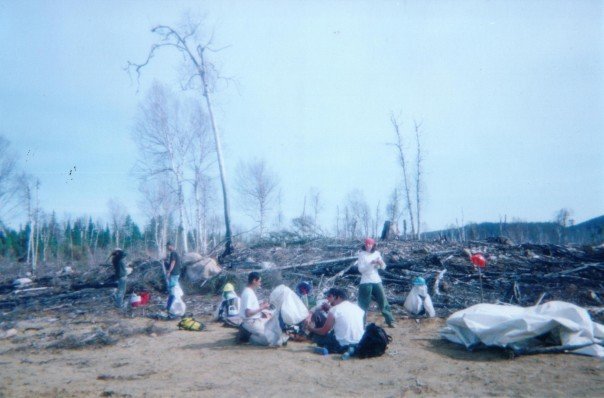
Gerard’s personal hierarchy consisted of the following: at the top, himself, followed shortly thereafter by his two dogs, then God, his boots, a host of inanimate objects, then us. Stomping up the bus steps, he’d bark at his dogs to crawl into the seat beneath him, and his furry beasts, half husky, half wolf, would crunch into that small space with their legs splayed like squished bugs and hunker there the entire ride.
The days and evenings were eating the nights. On the bus one morning, right after I was transferred to Gerard’s crew—forehead pressed to the back of the seat ahead of me, arms dangling—just as I was sinking away I opened my eyes and saw a furry paw sprawling into my foot space. I picked my foot up and rested it on the lip running down the edge of the bus. The furry legs pushed on and became furry haunches, a bushy tail, and soon I was looking down at a cold blue eye studying me from the darkness of the floor, and there were too many teeth down there.
I’d been glad to find a seat empty seat even though I’d slept late, right behind where Gerard usually sat. I’d noticed it was usually last to be filled.
The other dog, the alpha bitch, sprawled further into the aisle, growling at Regular Dan in the seat opposite. Dan pretended to watch the trees whizzing by his window.
His eyes closed, Gerard chopped the air, twisting his hands inside and out, his face placid, his kung fu preparations, trying his best to forget the rest of us existed.
∞
It rained my third day in that piece.
I will not quit.
As it did every day.
I will not quit.
We had no option to dry.
The white trees, trying to drag me into the bog to gray and petrify like them, grabbed for my bags, spilled my trees, raised red blossoms across my shins, my face, my neck. Every time, that impulse of rage would rise. Let it go. I’d swear, smash my shovel against the ground, kick at the stick that had hooked me—at the very least grab it and try to snap it in two, and sometimes the stick would bend but not break and I’d grab it and yank it, try to haul it out of the ground, and when the roots wouldn’t come I’d twist it and twist it and twist it until it popped free, but there’d be no satisfaction at all. By then the stick had already won.
Always there was the compulsion to make animal noises in my throat and hurl my shovel as far as I could. Only the worst times would the shovel get thrown, when I lost all reason and the growl came from too deep down. Most of the time, beneath the insult of the immediate moment, the fury remembered the limp crawl to retrieve the shovel across the same frustrating landscape that had spurred the rage in the first place.
I will not quit.
I did my best not to rage at the sky or uncoil my tongue with curses—the bullying trees would only drink it in and grow more coarse and stout. As often as possible I balled my frustration tightly, my teeth moving in my mouth, and stared straight ahead to where the next tree was supposed to go. Is that rock? A muddle of water?
Even in early June the nights were still cold, and without sunlight the ground wouldn’t warm enough for tiny wings to take flight until later in the morning. If we were lucky the rain would be sleepy too. We could keep our raincoats in our back bags and expose our skin to the air, not worry about heat, sweat, only work. Around ten the first bug would bounce off a cheek. Brush it aside. Head down, move on. Then that first bug would be followed by a friend, a cousin, an acquaintance. Soon it would be a whole family reunion, and we were the Thanksgiving feast. Thank you, oh Great Creator, for this offering of stupid boy that we are about to receive.
All day the bugs were thick as fur over my body. I had my pant’s cuffs duct-taped, my wrists taped, my shirt tucked into my pants, my collar cocked. I hauled a bug net down over my helmet and sprayed deet on the back of my neck and slapped it all around my raised shirt collar. The flies would land near a boundary of tape and shirt and walk the rest of the way to their dinner: under my glasses, behind my ears, under my armpits, around my wrists, encircling my waistline, and especially around my poor unprotected neck—like bloody oatmeal on the bus every day after work—the smell of my hot jugular like sweet ambrosia to my tormentors. Already itchy with the sweat and the mist, all I could do was ignore the swarms the best I could, keep working, and every day return home a half-chewed raspberry of a man.
Having to stand still to drink, the yoke of dehydration would grow heavier as the day wore on. I would slow. Looking down, my blue Dickies would be a moving black mat of bugs, seeking entry. The sheer numbers were fascinating. Numb to the invasion of my person, I watched their meetings and collisions, every inch of my thighs, knees, calves bloodthirsty baubles, all wanting the same thing: my body for their food. Incredible. I stared. No wind. Hot inside my net. Wet inside my clothes. Cold inside my skin. Amazing.
∞
Thanks to Ian and his Insects of Northern Ontario book, I knew the mosquitoes looked like plague doctors, with long proboscises under big bulging eyes. They’d inject us with a thoughtful sedative and take their fill daintily, very civilized. The black flies, on the other hand, were brutal thugs with rasping fangs and obscene tongues. Landing, all they wanted was to find an unprotected glut of squishy flesh, and with their terrible jaws rip me open and lap down like dogs to take their fill. Those goddamned little bastards, I watched them stick their butts up into the air to drink of my precious ichor far too often. Even now I’m calloused about it. That was my blood they were taking. I needed that.
With a grunt I'd slap my hand down. A massacre. An exodus. The black cloud would follow, waiting for me to tire again.
I would fashion faces for them based on what I’d seen in the pages of Ian’s book, adding detail, making them more human, perhaps so I could more easily believe I could reason with them—the mosquitoes like prognathic mustachioed visages in vintage gasmasks, blank uncaring stares; the black flies like bucktoothed rabid creatures prodding with imbecile determination.
Looking at my arms and legs and chest, I’d see thousands of those faces—kaleidoscopic visions of black snouts snuffling over my clothes, seeking entry, seeking my blood. Seeing they had faces I could only believe they were ignoring me, could only believe they were seeking to drive me crazy.
Why was I enduring this? How could I make it stop?
Anthropomorphism outside of storybooks can only create cold villainy.
I would work through the clouds of bugs as long as I could, practicing Zen-like resistance, then I had to hunker down on a log or a stump, lower my head to my lap, raise my net and cup my hands around my face at the eyes, making a little space in the world where I could feel the air on my skin and not be bothered by the black flies. That refuge behind my hands was mine. I needed it. It was the only way I could keep the traveling fiction of myself from flying apart for a while longer.
Even there the black flies would land on my legs and wriggle into my line of sight. I squished those intruders into my intended calm—black flies have a satisfying pressured pop to them—and raised them aloft for the rest of the bugs to see. You see that? That’s you if you don’t leave me alone! I’ll kill you! Trying to reason with the bugs is a recognizable symptom that presages a total breakdown. We all did it, hearing tinny laughter in return.
In signing myself up for the haphazard tour of the woods, I had expected an ordeal, expected to be flayed by the experience down to some rudimentary skeleton and remade anew. And thus far I was not disappointed. Except, as I came to fear the lightening blue of my tarp as I woke numerous times in the night, and fought the discomfort, the fatigue, the seesawing between rage and determination, I began to struggle to believe that the hardship had meaning.
More and more I’d had to bend to my imagined world, remind myself that I was cocked and aimed in a strange new direction, that the work only got easier—until the job itself was hardly in focus anymore. It was the story I had come to believe in. Days were rewritten with a slant towards a happy ending. Hardships and failures toughened me for future denouement. All a part of the plot. Ending would be sweet, personal reward, journey of character complete.
Meanwhile, the contract remained a gray, moneyless meat grinder, and my fuse was guttering. I could hardly imagine a day where I didn’t wake to uncomfortable, frustrating toil, food for a billion black dots. I had forgotten what my story had been in the time before the big green bus. Now I was like the sideways stunted spruces the skidders had crushed, struggling to find light in this boundary place between man’s world and the darkness at the edge of the forest.
After three days wandering lonely and cold through the ant farm, I stuttered to a full stop in the middle of a small clearing, an apostrophe in the forest. I looked at my arms and I did not see flesh and bone. I saw wireframes of words moving fluidly over a folded landscape, moveable white noise.The fiction I had fashioned for myself sloughed from my shoulders like wet paper. Who was I trying to kid? I was no burly bush man. Black bugs were biting my pink wrists and I was bleeding red blood. I had made myself into a pleasant prosy character of rugged Canadian woodsman, but finally I was unable to hold on to that story I’d worked toward and it was all coming apart. I had no more accommodation for myth.
I sat down on a log, and hidden there in my hands from the bugs I tried to cry. I reasoned that if I could squeeze out a few tears I could dial the frustration down to a manageable level. But I hadn’t cried since my nan had died five years earlier. Manly burly men don’t cry, remember? Only I didn’t care about that anymore. I could no longer fool myself into following the plot I had written. I still had faith in the outcome of the story, but I had to face reality—I wasn’t making much money, I wasn’t very good at this job that I had elevated so highly, and every day I hated tromping through the sloppy margins of the forest more and more.
All the old ideas I had brought with me were lying about the forest floor in piles, draped over stumps and hanging from sharp sticks leading back through the skid trails. I was cold and wet and lonely. Just a jot note now. If I moved forward at all, it would have to be without the cushion and comfort of prologue. In a way I had gotten what I had originally wanted, a change of chapter, even if I hated it at the time.
CHAPTER 12
LIKE WATER TO THE PARCHED EARTH
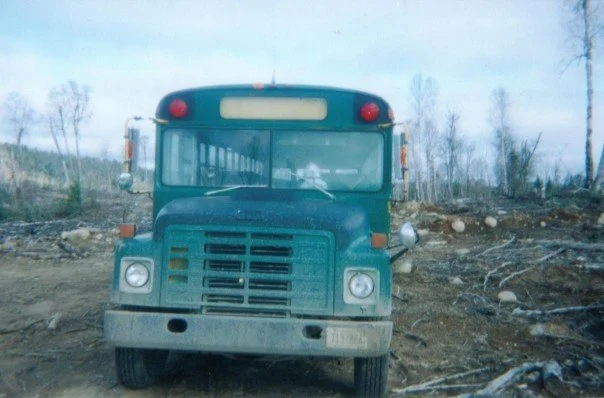
All the crew bosses had a knack for sneaking up on us in our worst moments. Kate was notorious for it, but at least she kept it light, mugging for a laugh. Gerard, not so. I looked up from the sanctuary of my hands to see Gerard watching me from twenty feet away, framed by pillars of trees, flanked by his dogs on either side, a statue of a man who would cast miscreants into pits, and use words like “flay,” “skewer,” “disembowel.”All three were staring at me icily. Immediately I felt shame for being caught sitting, the unpardonable sin, and hated that Gerard had seen me dismayed.
He eyed the mounds of paper that had fallen from my shoulders, surrounding me in clumps. In his monotone, he asked, “How’s it going in here?”
“Fine,” I said. The only answer allowed a man.
“How much longer you think you’re gonna be?”
I’d been wandering around the ant farm for three days. I didn’t know where I was, or how much land was left, and I told him so. I showed him bundles of frozen trees in my bag. I couldn’t plant those if I couldn’t pry them apart.
Gerard’s expression never changed. He stared at me long moments before he said, “Trees look okay. I’ll be down the road if you finish.” Gerard turned around and vanished into the forest.
I didn’t think I’d ever finish. For days I’d been plugging trees into the ground primarily for reasons of boredom and proximity. When it was easy I could care. When it was hard I could never consistently make myself move. I would get up and move on because there was nothing else I could do.
I bagged out a short while later, aided by the bundles in my bag frozen together like popsicles, and wound through the skid trails back to the road. I felt relieved to jump down the berm off my piece and walk easily on hard ground. It was like moving from one world to another. Gerard was counting trees at my cache, spreading frozen bundles across the landing to thaw. The air was a murk of cold drizzle. It would take a long time.
Gerard had pulled the Silvicool tarp off the tree cache and my bag wasn’t where I’d left it.I asked him if he’d seen a black canvas knapsack with a drawstring and leather straps. He said, “No,” and went back to his frozen stock.
I found it twenty feet away down in the ditch, my Tupperware container broken open, my lunch scattered, my sandwich, my crackers, my precious cookies half eaten and strewn along the muddy bank by a half-stogged culvert. Tooth marks in the top told me what had happened. I called out to Gerard.
“Hey, one of your dogs broke into my bag and ate my lunch.”
Gerard hardly looked up from his boxes. “Yeah, Naia does that. She’s an alpha bitch. Tie your bag tighter.”
∞
I clomped four hundred meters down the road to bag up from another cache, and there I discovered GlassesColin sitting half beneath the Silvicool tarp, eating his sandwich out of the rain, his glasses steamed. The times I’d heard somebody screaming the past few days, it must have been him, wandering about his own ant farm next to me. I sat on my day-bag next to him at the cache and he laughed when I told him about my lunch. Personally, I thought it a travesty. My crew boss was supposed to help me, not take from me. I’d only eaten a bowl of cereal for breakfast four hours earlier, quick and easy. Now I was readying myself to experiment with a healthy lunch of pine cones, dirt, and random mushrooms. How was I supposed to plant another six hours without food? Had Gerard watched his dog steal my lunch?
Colin said, “Yeah, that’s happened to all of us. She tore a hole in my nylon bag. I had to buy a new one.” He chuckled again, though it echoed out of a hollow heart.
He gave me an apple he didn’t want, default artefact from a sub-level in the basement of his bag, for which I was grateful, and we sat by the cache in our personal fortresses of nets and polyester, lifting the bottom of our bug nets when we wanted to take a bite. The mesh caught on the prickles of our beards.
I found a forgotten baggie of trail mix in the bottom of my bag, the clear plastic turned opaque, and ate that too, mostly raisins and peanuts. Every planter has a baggie of half-eaten trail mix buried in the bottom of their bag, a protective instinct inherent in the breed. Sick of soggy sandwiches suffocating in mayo and tough, gray luncheon meats, most days on the block I was eating nothing but oranges and chocolate chip cookies. I was fueled by sugar. My filthy dress shirt hung from me like a cape. I was ribs with muscly bananas of arms stuck on, shoved down atop bulbous pistons of legs.
The drizzle thickened to a rain and we shrugged into our raincoats. Colin reapplied his bug repellent, which hadn’t yet been legislated to contain non-poisonous levels of deet. We were told not to spray our helmets—the deet would eat right through the plastic—but we bathed in the stuff first thing in the morning, reapplied at every bag-up, and bought new bottles on the days off.
“Check this out,” said Colin, unscrewing the cap of his little bottle. “Ah, man, I do this every day. After work, usually.” He plucked a black fly off his arm and dropped it into the cap from the bottle. The black dot wriggled in a pool of ninety-nine percent deet.
“Die, fucker,” said Colin.
We watched the bug rapidly dissolve into a black greasy smear.
“Best part of my day,” said Colin, and his eyes gleamed. And I knew what he meant.
∞
The rain stayed steady the rest of the afternoon and I pulled my stub of a watch out of my pocket often. I was tired and empty, miserable right down to the boots of my soul. Money didn’t matter. Just get me out. Just let me lie in my tent and read. Forget the world. I just wanted to be warm, to be alone under my own conditions. I no longer had any ambitions higher than the base animal desires to be fed, dry.
When it got close enough to quitting time to leave, I angled out of my ant farm via a different path than I had before. Between me and the road I ran into a field of eye-high grass, with top-heavy stalks that whisked and moaned in the wind. A moose trail had been trampled through the middle and I wouldn’t have to get extra wet blazing a trail of my own at the end of the day. I had learned that lesson early. It doesn’t matter how wet you already are, you can always get more wet.
Five feet in front of me, with my first step into the grass fifty dragonflies took flight. I stopped, surprised, assessing the danger. Dragonflies have mouths that clamp like calipers. I stepped. Fifty more dragonflies burst into the air, their bodies blue, red, green, yellow, flashing in the light as they hooked over the tops of the tall grass and vanished. I stepped. Fifty, a hundred, two hundred dragonflies took flight. The air sparkled with them like gems. I bent my rain-blacked boots through the grass then and stepped and stepped, a giant joyfully trampling a countryside. An endless concussion of colour leapt left and right, thousands upon thousands of hungry hunks of rainbow with terrible jaws fleeing, savage ugliness coupled to grace in flight.
After I had passed, I looked back through my path of destruction conflicted with delight that it had happened and remorse that it couldn’t last longer, and probably would never happen again.
Beauty, like joy, comes only in so many precious packets parcelled out to us over the course of our lives. Sometimes we’re not ready and can barely appreciate what we’re seeing at the time. Other times, beauty comes like water to the parched earth.
